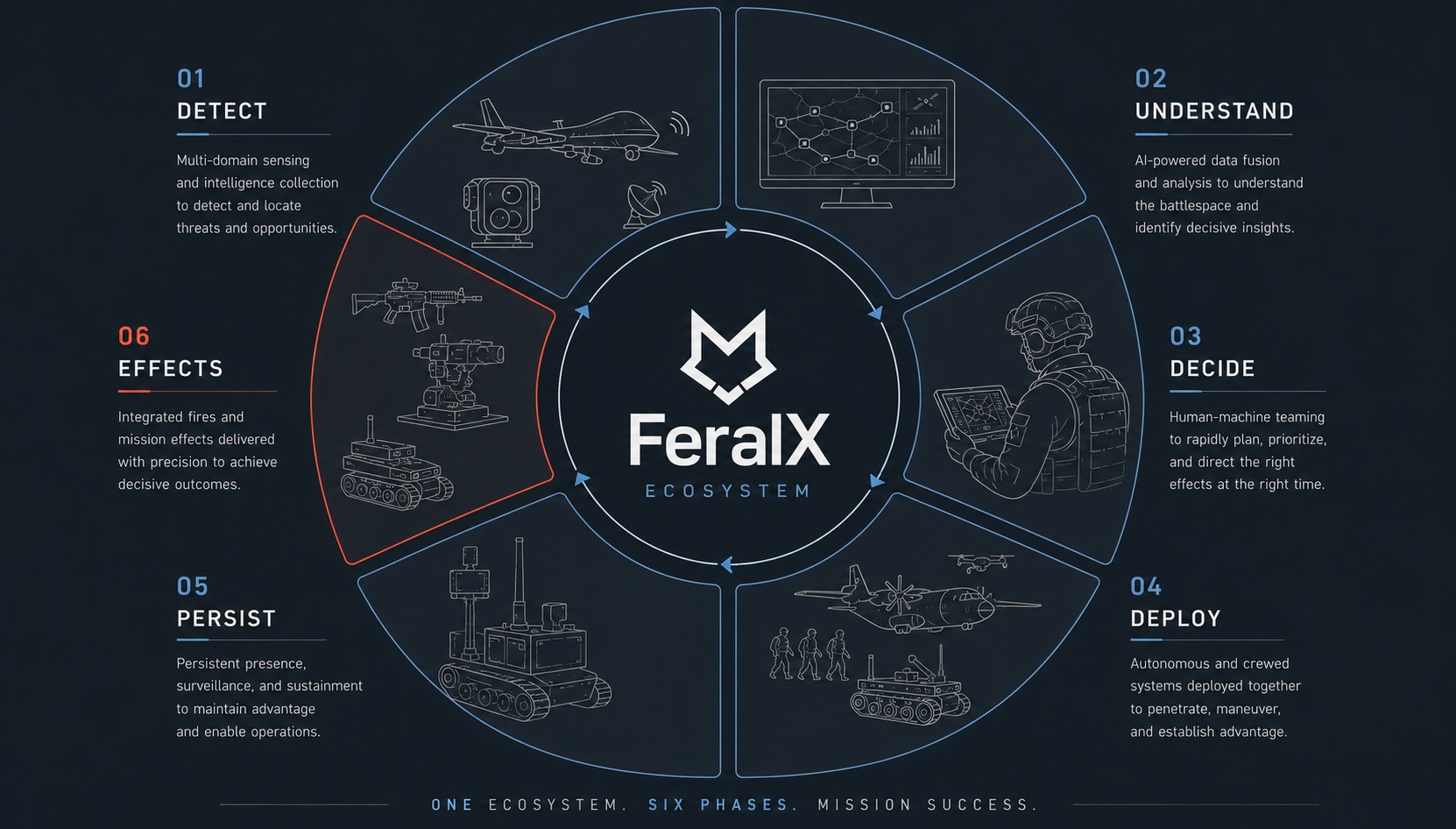

Every FeralX capability exists for one purpose, helping operators detect, decide, and deliver effects faster.
Weapon systems and man-portable UGVs, designed and built by FeralX, the core of the ecosystem.
Manned and unmanned ISR and aerial systems delivered through disciplined strategic partnerships.
AI sensor fusion connects operators, sensors, and machines into a single common operating picture.
Persistent surveillance from manned aircraft, unmanned aircraft, and autonomous ground systems creates continuous battlefield awareness.
Man-portable aerial and ground drones reduce operator workload while extending reconnaissance, logistics, and precision effects far beyond visual range.
Integrated operator weapon systems, from sidearms to sniper systems to belt-fed platforms, provide mission-tailored kinetic capability for every operational requirement.
Every sensor, every platform, and every operator contributes to a single real-time operational picture.
Speed of thought, weaponized.
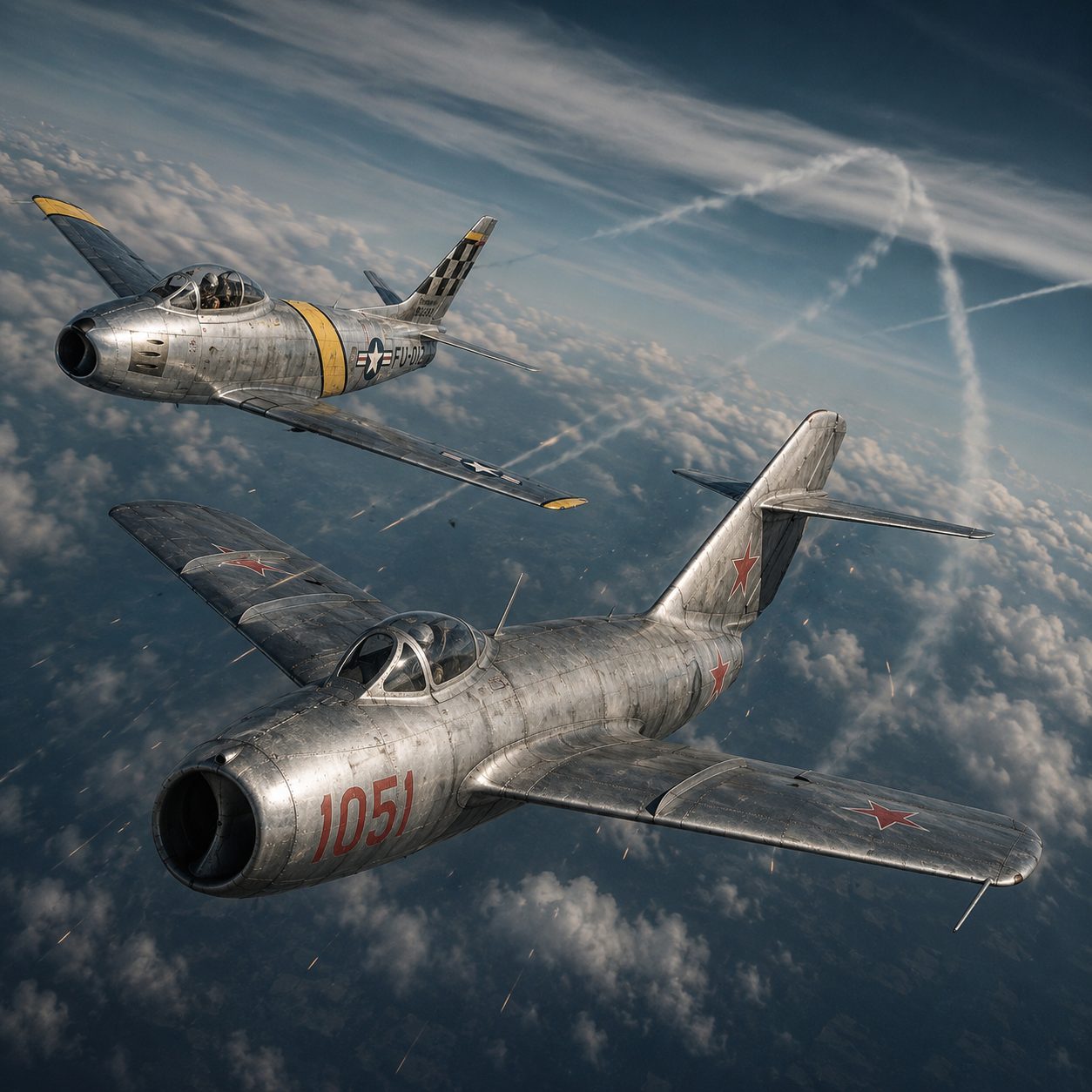
US Air Force Colonel John Boyd asked why American pilots dominated air combat over Korea while flying an aircraft that was, on paper, outmatched. The MiG-15 climbed faster and turned tighter than the F-86 Sabre. The Sabre had two quieter advantages: a bubble canopy its pilot could actually see out of, and hydraulic controls that turned intention into movement faster. Boyd’s conclusion reshaped military thinking. Victory does not go to the stronger side; it goes to the side that cycles through observation, orientation, decision and action faster than its opponent. He called it the OODA loop. Operate inside an opponent’s loop and their actions arrive too late to matter; they are forever responding to a situation that no longer exists. The FeralX Mission Ecosystem is built directly on Boyd’s work, every platform we make exists to run the operator’s loop faster than the other side’s.
Everything downstream of observation inherits its quality. A force that cannot see cannot orient, and a force that sees late decides late. This is why intelligence, surveillance and reconnaissance is not a supporting function; it is the front of the loop. Persistent airborne ISR widens the aperture. Sensors pushed forward on uncrewed platforms watch the spaces too dangerous or too dull for people. Better observation is not more data; it is earlier, cleaner contact with reality.
Boyd considered orientation the most important stage, and it is the one most often skipped. Orientation turns raw feeds into meaning: what is happening, what it implies, what matters now. It is shaped by training, experience and culture, which makes it the most human stage of the loop, and the most trainable. Two crews can watch the same feed; the trained crew sees a pattern while the untrained crew sees pixels.
Good orientation compresses decision. Commanders who understand the situation choose among prepared options; commanders who do not improvise under pressure. Decision speed is not recklessness; it is the dividend paid by everything that came before it.
A decision that never becomes an effect is a rehearsal. Action is where weapons, platforms and logistics convert choice into consequence: the effect delivered, the position taken, the capability kept in the fight. Then the loop restarts, and this is the compounding secret of tempo. Each cycle completed faster than the opponent’s widens the gap on the next.
HOVER EACH STAGE TO SEE HOW IT WORKS.
BOYD’S LOOP, MAPPED TO THE FERALX MISSION ECOSYSTEM.